
Repeat
{"each": data, "do": node} stands for one node per item, in place, wherever a child can go.
{
  "name": "Week",
  "gap": 12,
  "padding": 20,
  "fill": "#FFFFFF",
  "cornerRadius": 16,
  "column": [
    {
      "text": "Minutes practised",
      "font": "Inter 13/18 600",
      "color": "#6F6879"
    },
    {
      "row": [
        {
          "each": [
            {"d": "M", "m": 40},
            {"d": "T", "m": 25},
            {"d": "W", "m": 55},
            {"d": "T", "m": 30},
            {"d": "F", "m": 60},
            {"d": "S", "m": 15},
            {"d": "S", "m": 45}
          ],
          "do": {
            "column": [
              {
                "type": "rectangle",
                "width": 24,
                "height": "{m}",
                "cornerRadius": 6,
                "fill": "#F29F05"
              },
              {"text": "{d}", "font": "Inter 12/16 600", "color": "#6F6879"}
            ],
            "gap": 6,
            "align": "center"
          }
        }
      ],
      "gap": 10,
      "align": "end"
    }
  ]
}
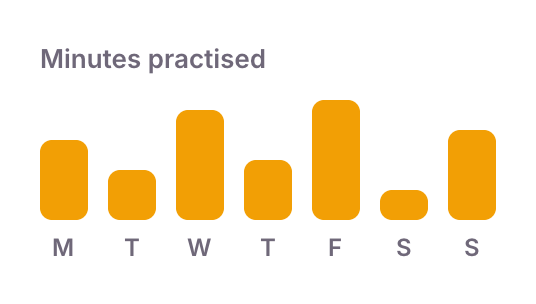
Seven bars from seven objects. "height": "{m}" takes the number itself, so the bar heights are the data.
What can be substituted
| Write | Becomes |
|---|---|
{.} | the item itself |
{field} | a field of an object item |
{i} | the index from 0 |
{#} | the number from 1 |
{n} | how many items there are |
data may be a list or a count: {"each": 12, "do": {"text": "{#}"}} makes 1 to 12. A string that is only {name} keeps the value's type (a number stays a number, a list is spread into the list around it); inside longer text the value is written as text.
With parts
each and parts combine: {"each": ["Sa", "Re", "Ga"], "do": {"chip": "{.}"}}.